Thursday, June 13, 2013

The Stories I Rub Shoulders With - New Post at Everyday Liturgy

I have a 1938 edition of Webster's Students Dictionary: Upper School Levels on my shelf. It's my go-to resource for the definitions of words I find in old books. Some of them are words we still have today, but so often their connotation has changed.

Take "charity" for instance. Today, the first definition most people would think of is an organization or system for giving to the poor. It's not a wrong definition at all, but it's not the main focus the word has always held. "Charity" is an old-fashioned word, one that in my 1938 dictionary is primarily defined as "Christian love."

That's a challenging definition. I'm not sure that we could all agree on what "Christian love" looks like.

The secondary definitions begin to give it focus: 2. An act or feeling of generosity or benevolence. 3.The giving of aid to the poor and suffering. 4. Leniency in judging men and their actions.

Interestingly, the organization or institution for aiding the needy doesn't get mention until definition #5.

I've been thinking a lot about charity of late. I've been pondering through the idea, and particularly focusing on the "benevolence" and "leniency in judging men and their actions."

I've been thinking about kindness.

Some of these thoughts formed themselves into a guest post for Everyday Liturgy. Here's a snippet:
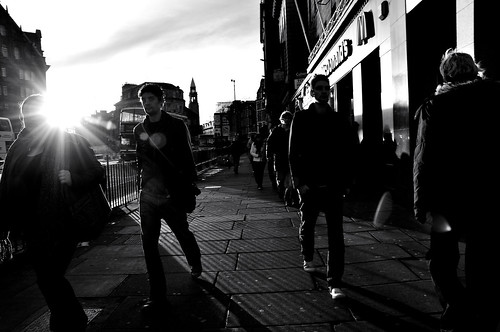
Photo by Loic Parent
I read a social media post recently in which the author chastised himself for making snap judgments about the people he was seeing in the airport. I can’t remember who posted it or where, but the author challenged his readers to extend grace rather than judgment toward those we see around us. It was a good challenge, a gentle reminder. But as I thought about it, I realized that my observations of those around me rarely lead to what I would consider judgment.
Read the rest over at the site.

Wednesday, June 05, 2013

The Race That Knows Joseph

“They’re our kind of people,” Julie said.

It’s the sort of phrase that could be cruel. It could be unkind, exclusive, evasive. But the way she used it, it was none of those things.

"Couple on Two Benches"
George Segal
Source: Sculpture.org
She was referring to what Anne Shirley, as a child, called “Kindred Spirits.” Later, when she grew up, she adopted the term her friend Miss Cornelia used, “The race that knows Joseph.” I have no idea where L.M. Montgomery came up with that phrase. I presume she is referencing one of the biblical Josephs, but I honestly don’t know. I only know that she somehow found the perfect description for “our kind of people.”

The race that knows Joseph are actually a fairly broad and diverse lot. They like all kinds of different things. There does tend to be a bookishness about them, but they’re not limited by those books. There are scientists, athletes, English professors, historians, sea captains, and doctor’s wives…all who belong to the race that knows Joseph.

It’s a bit of an intangible descriptor. There are, after all, two biblical Josephs. I think an argument could be made for either one to be him who is referenced. The Old Testament Joseph, Jacob’s son – he of the Amazing Technicolor Dream Coat – was a dreamer and an old soul. He was a gifted manager and strategic planner. Through his life he learned to see the big picture and to glimpse things from God’s perspective. I’d wager this is the Joseph that Montgomery’s Miss Cornelia is referring to, but I often wonder if maybe, just maybe, it’s the other one.

The other Joseph, the New Testament Joseph, of the house and line of David, is a quieter character than the Dream Coat Joseph. We only get a few chapters’ worth of glimpses into this Joseph – who also had a father named Jacob – but they are telling glimpses. He is a man who speaks with angels. A man who rises up and takes his pregnant fiancée into his home, marrying her despite the whispers of the people around them. He is a man who raises a Child he knows is not his own, a Child whose depth and wisdom are confounding to the carpenter. He works hard, and – it seems – he dies early, before seeing how the Boy he raised turned the world upside down.

I think both Josephs would be “our kind of people.” I think they both would find that chord of resonance with the other. But Technicolor Joseph would be up front leading the group, laying out the plan of events, and Carpenter Joseph would be working hard behind the scenes.

Whichever Joseph it is that we know, “our kind of people” all know him. 
“You’re young and I’m old, but our souls are about the same age, I reckon. We both belong to the race that knows Joseph, as Cornelia Bryant would say,” said Captain Jim. 
“‘The race that knows Joseph?’” puzzled Anne. 
“Yes. Cornelia divides all the folks in the world into two kinds– the race that knows Joseph and the race that don’t. If a person sorter sees eye to eye with you, and has pretty much the same ideas about things, and the same taste in jokes–why, then he belongs to the race that knows Joseph.” 
“Oh, I understand,” exclaimed Anne, light breaking in upon her. “It’s what I used to call–and still call in quotation marks ‘kindred spirits.’” 
“Jest so–jest so,” agreed Captain Jim. “We’re it, whatever it is. When you come in to-night, Mistress Blythe, I says to myself, says I, ‘Yes, she’s of the race that knows Joseph.’ And mighty glad I was, for if it wasn’t so we couldn’t have had any real satisfaction in each other’s company. The race that knows Joseph is the salt of the airth, I reckon.”*
*Montgomery, L.M. Anne’s House of Dreams. New York: Bantam Books, 1992. p. 38. (©McClelland and Steward Limited, 1922.)


Tuesday, June 04, 2013

Hopkins, Kingfishers, and Identity

Photograph by Charlie Hamilton James
Source: http://dailym.ai/14dMwTJ
As kingfishers catch fire, dragonflies draw flame;
As tumbled over rim in roundy wells
Stones ring; like each tucked string tells, each hung bell's
Bow swung finds tongue to fling out broad its name;
Each mortal thing does one thing and the same:
Deals out that being indoors each one dwells;
Selves — goes itself; myself it speaks and spells,
Crying Whát I dó is me: for that I came.

I say móre: the just man justices;
Keeps grace: thát keeps all his goings graces;
Acts in God's eye what in God's eye he is —
Chríst — for Christ plays in ten thousand places,
Lovely in limbs, and lovely in eyes not his
To the Father through the features of men's faces.
 -Gerard Manley Hopkins
I am what I am, and what I am is Christ.

Source: Gerard Manley Hopkins: Poems and Prose (Penguin Classics, 1985)

Saturday, May 11, 2013

Leaping

In less than two months, I will not be employed full time. It’s a slightly terrifying idea, but a step I’ve seen the Lord clearing the way for over and over as I’ve walked forward.

I talked with a friend about it a few months ago. I said something like, “I’m going to take a leap and leave this job to pursue other things.” He asked what I would be doing. I said I wasn’t quite sure, some things had fallen into place but much hadn’t. He said, “Well, I guess it wouldn’t be leaping if you knew where you were going.”

Photo courtesy of: http://francescakotomski.com/
That’s the thing about leaping. Knowing exactly where and how you’ll land is not guaranteed.

When I took my current job, I gave a handshake commitment to stay in it three years. That was a big deal for me. Since college, I hadn’t been in one place or one job for more than two years. When year 2.5 rolled around, I was getting pretty itchy. I’d been there a long time. I began to do a little bit of looking around to find out what other jobs were out there that I might be qualified for. And then, right about the three-year mark, my boss died and the University decided to change its name. Personally or professionally, it was not a good time to make changes.

So I stayed through year four. And it’s been a good job. I love the team I work on and I believe in the place I work for. What more could you ask for?

The intersection of gladness and hunger.

Frederick Buechner wrote in Wishful Thinking: A Theological ABC that, “The place God calls you to is the place where your deep gladness and the world’s deep hunger meet.”

I haven’t found that place yet. And the conclusion I’ve come to in the past months is that I’m not going to when I’m working in a full-time job that keeps me insanely busy, creatively depleted, and emotionally over-invested. It’s a good job, but it is not the right one for me in the long run.

So I’m leaping. I’m stepping out and exploring my options. I’m picking up freelance editing and writing work, I’m teaching adjunct, and if need be, I’ll find something part-time to fill in the gaps (one does, after all, have those pesky things called bills).

But for the first time in a long time I’ve ceased striving. When the panic of the unknown rises, I place it into God’s hands and know He will carry it. He’ll make the connections that need to be made – I’ve been watching Him do so already.

As I leap, will you do something for me? Will you pray with me and for me that God would show me the place where my deep gladness and the world’s deep hunger meet? I’m closer to that place than I used to be, but I know I haven’t yet quite found it.

Oh, and if you know somebody looking for an editor or proofreader, would you point them my way? Thanks.☺

Thursday, May 09, 2013

Bent Branches, Straight Baselines


It’s been just over a month now since spring began – slowly this year in Philly – coming at us in fits and starts. I think it has actually arrived now, though there are still one or two trees that are only just leafing out. But the azaleas and the dogwoods have bloomed, so I think it’s really spring.

This slow spring has drawn my attention more than once – trees that often bear the bright of yellow-green in March still showed their naked limbs well into April. It was as if they wanted to say, “See, here’s my structure. These are my bones. You may not have noticed them this winter when your eyes were cast to the ground watching for ice patches. Look up now; see my angled boughs.”

At the beginning of April, my friend David posted a short piece on his blog titled simply, “On Baseball.” In it he quickly and poetically examined the architecture of a golf and baseball, finishing with these words:

Baseball unites heaven and earth: it inscribes a pattern of clean lines, orbs, and diamonds upon the dust from which we were formed and in which we toil, and the lush green in which we find rest. Upon that heaven-and-earth field, prodigal sons set out on barren base paths; and we watch and wait to see if they will make it back home.

The words arrested me. I love clean lines. I love the straight, the symmetrical. There is beauty in a ballpark. But as the trees bared themselves, I had the realization that straight lines are a rare thing in nature. The Creator’s beauty meanders more than man’s.

And when we humans create without the assistance of our man-made tools, our creations are meandering things too, the image of God creating in the pattern of God. As I began to think it through, I realized that the straight lines and measured curves of architecture echo the straight lines and measured curves of the heavenly throne room – and our ideals of beauty find their fulfillment in the descriptions of that place.

Somehow, we find ourselves caught in the middle, loving both the bent branches and the straight baselines. Caught between heaven and earth. Redeemed yet human. Prodigal sons looking for home.

My first inspirations on this topic formed themselves into an essay for The Curator, the web publication of the International ArtsMovement for which I am now serving as an Assistant Editor.

David’s continued thoughts on the topic have been manifested in a second blog post where he says kind things about my Curator essay and much better things of his own.

Thursday, March 28, 2013

Radio Silence

I’m planning on going dark on social media over the next day or so. Partly, it’s for my own sanity; once in a while, I just need a cleanse. Need to stop being bombarded by the constant noise of online interaction. I love it – don’t get me wrong. My extrovert comes out in full force on social media; likes and comments, retweets and interactions are her drugs and she just needs a fix. But sometimes I realize that I’ve been living so much through my online interactions that my soul has begun to fray around the edges. And so I go dark – maybe for a day, maybe for less, maybe for more – and I shut off the noise, and I detox.

But this time it has a secondary purpose. I’ve done this radio silence at this time of year before. It is especially meaningful now, this weekend, more than others.

For this is the time when God went dark.

I wonder what it must have been like on the day of the crucifixion to see the sky growing dark in the middle of the day. I wonder if there was silence in the Temple after the priests heard the veil rent from top to bottom. I wonder how John must have felt, this woman, his Teacher’s mother, commended to his care, with no more chance of hearing the caring tones of the One who brought them together. I wonder if Nicodemus and Joseph of Arimathea spoke as they took the Christ’s body from the cross and moved it to a tomb. I wonder how Peter longed to hear his Lord speak words of forgiveness of his denial.

There is silence in death. Whatever commotion comes before it, when the last breath is breathed, quiet falls. Whatever grief and keening comes after it, there is a moment – however brief – as the realization settles in, when silence reigns.

There is darkness in death – both spiritually and physically. The eyes close, light no more to enter or exit them. The light that is personality, life, spark – the beaming smile, the sparkling eyes – goes dark. Before candles are lit in memory there is the closing of a casket, shutting out the light.

The Tenebrae service recognizes the darkness of death, the quiet of it. One by one, as the passages walk us through the darkness of betrayal, the darkness of Gethsemane, the darkness of denial, of accusation, of death, of burial, candles are snuffed and the light goes slowly from the room. And in the end, we sit, silent, in the darkness.

I’m going dark this weekend to meditate on the darkness of the death of Christ. The silence of God in a time of need.

I am fortunate to know what John and Mary, Joseph and Nicodemus, Peter and the Priests did not know. I am fortunate to know that light shines in the darkness and the darkness has not overcome it. That knowledge changes my purpose as I take part in the silence, as I consider the darkness. Darkness now is not hopelessness. Death is now not an end.

The extinguished light in death is still real. The silence after the death rattle is still real. But I see them differently with what I know about the first fruits from the dead. A walk through a graveyard is a different experience when you know about resurrection.

Russ Ramsey, in “The Last of a Generation,” writes:

Over the years, as this church's property has yielded to progress, the original sanctuary has expanded to add a wing of classrooms, offices, and the small chapel where we gathered to remember Nana. Filling the yard to the east of the sanctuary is a cemetery with ghost-white limestone markers dating back before the Civil War. They stand tall, thin, and rounded. I see one that actually bears the inscription "R.I.P."

When it came time to build a fellowship hall, the land to the west was already developed to capacity. So they built a stand-alone structure on the east side of the cemetery. The strange effect is that for a person to go from the fellowship hall to worship, they have to pass through the center of this garden of graves.

As we walk, my cousin points at a headstone bearing my mother's maiden name-Aspinwall...Just like the others, this headstone offers nothing but a name and a date. Yet for every pilgrim moving between the fellowship of men and the sanctuary of God, these headstones-like a choir half buried, half rising from the dead-sing the same refrain: For everything there is a season, and a time for every matter under heaven: a time to be born, a time to die, and a time for the life that happens in between…

I don't have all the time in the world. One day I will leave this fellowship of the saints I love so much, and I will step across that threshold into an eternal sanctuary of exultant praise in the presence of the Maker and Lover of my soul. Between the two I will be buried. People will gather and offer words in my memory. They will lay my body down in a grave and my headstone will rise from the dirt and join the chorus in the land of the living, singing: "A time to be born, a time to die, a time to live again."

Nate Wilson says that in death we are planted, that graveyards are a garden planted with seeds.2 “These are seeds, these are human seeds waiting a long time to break the earth, to grow…As Christians with faith, we know that when we walk a graveyard we are walking a Farmer’s field. And we’re not the Farmer. This is not our field. This is Somebody else’s field. This is His crop we’re walking on…the entire globe has gone from one little garden to an entire sphere that has been planted. This world is God’s garden. This world is His field, and there is going to be an enormous harvest. The corn will see the springtime. When the end does come, I think we’ll see an eruption. I think the resurrection is going to come with thunder and it’s going to be more dramatic than any spring has ever been.”3

Where, O Death, is now thy sting? Swallowed up in victory.

I’m going dark for a time this weekend. Radio silence. I am taking time to consider the darkness, to listen to the silence.

For anticipation is part of the gift. Crocuses bloom through dead leaves, making them beautiful again.

Easter is all the more beautiful when examined through the lens of Good Friday. Resurrection morning is coming. It will be all the brighter if I consider what it took to get there.

Notes:
1 Ramsey, Russ. “The Last of a Generation.” The Molehill, Vol. 1. Nashville: Rabbit Room Press, 2012. p. 189-191.
2 Wilson, N.D. Notesfrom the Tilt-a-Whirl. Nashville: Thomas Nelson, 2009.

Friday, March 08, 2013

When Characters Come Calling

I met a boy the other day. His name is Peter. He's about 9 years old. He has a sister named Sam, and a mom and dad. He's cautious, smart, quiet, wise. He reminds me a lot of my nephew. He loves science and he's going to discover the great world of bugs this summer. He will learn that life is not forever what it always was. He will discover that change is difficult and unsteadying. And he will learn that there is magic in the world - in the minutiae of creation, in the wonder of imagination, in the love of family.

One of the people who will speak into Peter's life this summer is a older man named Ben Palmer. I met Ben years ago when he was living a different story. He was in crisis then, and while that is behind him now, I know that much of what I learned about him during that time will be seen in his interactions with Peter this summer. He will be hard-nosed and he will be truthful. He will be deeply broken and utterly renewed. And he will speak words to Peter that "alert him to the power he was perhaps too afraid to hope was real."

Perhaps it is strange to you that I seem to know so much about Peter's future though I only just met him. Don't worry. This prescience isn't wrapped in hocus pocus.

I've had encounters like this before. I once met a young man named William, and before we finished our first meal I discovered he had a whole story to live before I was done with him. And suddenly the name William just wasn't right - not if we were to be spending a good portion of the next few years together. So decided to call him Edmund and he looked much more comfortable with that name.

In Peter, in Ben Palmer, in Edmund, I have the unique opportunity to see the past, the present, and the future all together. I'm fairly certain I know where they'll end up, but I'm not quite sure. You see, they all surprised me when they came calling at the corners of my imagination. They could shock me once again with a sudden departure.

It's an imperfect prescience. They're breathing and living within their own stories. I hope to paint the canvas for them as they take the journey they're on. But I don't yet know what every bump in the road looks like. They may trip and fall. They may meet friends and enemies who surprise me equally when they come knocking with their stories fully formed, reaching back and reaching forward.

I met a boy named Peter the other day. He trooped into my imagination whole-bodied, meditative, and staring at a blank spot on the fridge where there is no summer calendar while he ate his waffles smothered in real maple syrup.

I told you there was magic in this world.


Note: I wish to thank Sam Smith and Kristen Peterson, friends I met last year at Hutchmoot, for their contributions to Peter's existence and Ben Palmer's new story. Hope you don't mind that he's not called "Sam Peterson." You never know when your words will spark someone's imagination. See, I told you there was magic in this world.